Friday, September 2, 2011

Canadian War Writing About Afghanistan – to August 2011


Having finished struggling and writing a new chapter on Canada in Afghanistan for my book Courage Rewarded, I thought I might conclude my efforts by posting remarks about the sources I have looked to, in order to understand the war. I will deal with books first, and later make another post dealing with articles.

I was very pleased to see the first books coming out on the Canadians in Afghanistan, particularly those written by soldiers who wanted to share their experiences with the rest of us. Now that the mission has closed down in July 2011, more will show up in the coming years, and those by knowledgeable historians will be particularly welcomed.

My only complaint is that the writings that have been published cover the years only up to 2006; and only one book deals with 2007. Beyond that, we have no good picture of what happened there aside from newspaper correspondents’ articles. I hope we see more soldiers who want to let us know what they experienced.

I make no guarantee that the following are the only books published up to August 2011 but here is my list:

  • Sean M Maloney, Enduring the Freedom: A Rogue Historian in Afghanistan (2005). Maloney is an associate professor of history at RMC and a very unconventional historian, describing his experiences as he joins American troops in operations that are part of the US Operation Enduring Freedom.

  • Sean M Maloney, Confronting the Chaos: A Rogue Historian Returns to Afghanistan (2009). The unconventional RMC professor heads off again to be one of the first to visit Provincial Reconstruction Teams in 2004 and 2005. A revealing account like no other.

  • Peter Pigott, Canada in Afghanistan: The War So Far (2007). The earliest book to describe the whole Canadian experience. It has been criticized for not having anything new, but there are things in this book that you won’t easily find elsewhere. A good record of the early years, as well as being a capsule history of Afghanistan from the 19th century to 2006.
  • Christie Blatchford, Fifteen Days: Stories of Bravery, Friendship, Life and Death from Inside the New Canadian Army (2007). An insightful look of the experiences of Canada’s first troops to serve in Kandahar, as journalist Blatchford travels along with and shares the hardships of 1 PPCLI in early 2006.

  • LCol Ian Hope, Dancing with the Dushman: Command Imperatives for the Counter-Insurgency fight in Afghanistan (2008). The inside story of Canada’s first battle group in Kandahar as told by the 1 PPCLI’s commanding officer along with his thoughts on fighting insurgents.

  • Kevin Patterson, Jane Warren, Outside the Wire: The War in Afghanistan in the Words of its Participants (2008). A valuable early effort to gather stories of personal experiences by soldiers, doctors, aid worker and journalists who went to Afghanistan in 2006.

  • Chris Wattie, Contact Charlie: The Canadian Army, The Taliban and the Battle that Saved Afghanistan (2008). One of the first efforts to fully explain Operation Medusa, written by a journalist in this case. It had been criticized that it over exaggerated the significance of the victory; but the battle truly saved Kandahar City.

  • Lee Windsor, David Charters, Brent Wilson, Kandahar Tour: The Turning Point in Canada’s Afghan Mission (2008). A marvellous military history covering the entire experience of 2 RCR Battle Group in Afghanistan in 2007, written by 3 noted military historians from the University of New Brunswick who were the first to have full access to official records.

  • Col Bernd Horn, Fortune Favours the Brave: Tales of Courage and Tenacity in Canadian Military History (2009). As part of a collection of essays on military history from Canada’s early years, one chapter deals with Operation Medusa using sources not found elsewhere.

  • LCol John Conrad, What the Thunder Said: Reflections of a Canadian Officer in Kandahar (2009). The story of how the first battle group to Kandahar was kept supplied, despite wide-ranging mobile operations and threats from IEDs, written by the commanding officer of the supply element.

  • Institute for the Study of War: 1) Regional Command South, http://www.understandingwar.org/region/regional-command-south-0: A good study analyzing the demographics and terrain of all provinces in RC(S) by a respected US think tank.

  • Institute for the Study of War: 2) Eric Fosberg, The Taliban’s Campaign for Kandahar. Afghanistan Report 3, December 2009. A broad but detailed independent look at ISAF’s and Canada’s experience in Kandahar in 2006 by a respected US think tank.

  • Col Bernd Horn, No Lack of Courage: Operation Medusa, Afghanistan (2010). The full story of Operation Medusa by a noted military historian and regular force officer.

  • Capt Ray Wiss, FOB Doc: A Doctor on the Front Lines in Afghanistan – A War Diary (2010). A very personal look at what life was like for a dedicated combat doctor at forward bases in Afghanistan.

  • Capt Ray Wiss, A Line in the Sand: Canadians at War in Kandahar (2010). Captain Ray Wiss returns to Afghanistan to work and treat casualties of war in forward operating bases.

  • Major Mark Gasparotto, Clearing the Way: Combat Engineers in Kandahar (2010). An unusual and detailed record of what combat engineers went through in Kandahar in 2006, participating in Operation Medusa and in building Route Summit under fire, and FOBs Ma’sum Ghar and Sperwan Ghar afterwards.

  • Adam Day, Witness to War: Reporting On Afghanistan 2004-2009. (2010). The insights of a journalist drawn to war, from the Canadian army’s early days in Kabul to combat outposts in Kandahar. Many of these essays have been published in the Legion Magazine. An honest and very personal look at what happens day-by-day when living with front line soldiers.

That’s it for now. What happened after 2006? We know the war got very nasty. Let’s hope someone can write about it soon.

Friday, May 27, 2011

Book Review: Welcome to Afghanistan

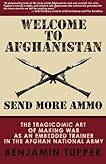
Welcome To Afghanistan: Send More AmmoWelcome To Afghanistan: Send More Ammo by Benjamin Tupper

My rating: 5 of 5 stars

As part of my research into the Afghanistan mission, I picked up a book written by an American soldier. The Canadian army has Operational Mentor and Liaison Teams working with their Afghan army counterparts fighting in Panjwayi and Zharey, but all these experiences are still classified as secret and hidden from public view. I hoped this author would give some insight into being part of an OMLT.

This author gives a simple honest description of combat in Afghanistan as part of one of the American army's 2-man teams which are mentoring Afghan army units. His short chapters are only 2 or 3 pages long but each concerns a dramatic incident he experienced. I like very much that he easily reveals the emotions and stress that resulted from his experiences, both on himself and on his close comrades. It still amazes me that he is not a regular army officer but a National Guard volunteer. Bravo him.


View all my reviews

Sunday, March 13, 2011

Book Signing at Place d'Orleans


My book signings at Coles in the Place d'Orleans Mall seems to be unusually good. The quiet Ottawa suburb of Orleans seems to to be a hive of people interested in military history. I was surprised at first, but then told that lots of personnel from DND Headquarters have chosen to live there. My book singing on March 12, 2001 was particularly satisfying. I met a presently-serving soldier who had won the Medal of Bravery in Afghanistan; a woman also in the Forces who has been in Kandahar as a supply clerk; a retired officer who had been the Canadian military attache in Paris when the Juno Beach Centre was officially opened; a retired soldier who had spent the first years of his long career in Camp Ipperwash in 1953 when I was there for the summer as a cadet (some of my best memories); a civilian who had just driven to Ottawa from far-away Labrador City to visit his daughter and who was keen enough to buy both of my books. It's meeting people like this that re-energizes me to write more about the Canadian military experience.

Wednesday, February 9, 2011

Preserving the Experiences of Veterans

The book Courage Rewarded is my attempt to record the experiences of Canadian soldiers who went off to fight in past wars, and to show the courage they demonstrated. With a similar intent, a number of groups are busy recording the memories of veterans still living, using video and the Internet. I think the best of these is "The Veterans." Jack Bennett's story of landing at Dieppe in 1942 is one of these and is well-told.

Sunday, January 16, 2011

The Tale of how Captain Oliver Mowat's Body Returned from Russian to Canada


I recently got another unexpected email from a lady in B.C. who wrote to thank me for mentioning her great uncle, Captain Oliver Mowat, whose story of courage in North Russia is described in my book Courage Rewarded. As part of her research into the Mowat family history, Carrie Mowat came across the mention of him in my book. She has now included all the material from many sources that she gathered about Oliver as part of her very comprehensive family web site.

Oliver was awarded the Military Cross for courage in battle in North Russia in December 1918 while acting as Forward Observation Officer with the 68th Battery of the 16th Canadian Field Artillery Brigade. However, one month later he was killed when he was part of the rearguard party that was holding off Bolshevik forces trying to surround Allied forces in the town of Shenkursk. While I included the story of this action in my book, Carrie was helpful in providing me with additional information about how his body was brought back to Canada for final burial. It seems that the men of his unit refused to leave him behind in North Russia with others who had been killed in the fighting, some of whom were buried in unmarked graves. His body was dug up, placed in a coffin “made up from soldered biscuit tins,” and loaded onto the ship returning from Archangel as baggage of the unit. On arrival in London, the body was collected by his brother, Captain Godfrey Alden Mowat, who arranged for it to be properly preserved by an undertaker and shipped back to Canada. On arrival in Canada, the casket was collected by his father, and Oliver was finally laid to rest in Campbelton Rural Cemetery with full military honours.


Carrie also told me that he is still remembered and honoured by the 68th Battery which still exists as part of the 15th Field Artillery Regiment in Vancouver. Carrie has donated Oliver’s medals and documentation to the Regiment’s museum. The regiment has purchased a shell casing from a howitzer with all the names of surviving members of the 68th Battery engraved on it and this will be displayed with a history to be posted on the wall of the armouries.

It was gratifying to me that Oliver Mowat was not left to be forgotten on the far-away shores of the Arctic Ocean, and that the courage of Canadian soldiers in this little-known campaign of the Canadian army is not forgotten.

Sunday, January 2, 2011

A Remembance Day Compliment from Arthur Rigby's Family regarding his Military Medal


On Remembrance Day 2010, to my surprise, I received an email from a lady I had never met, thanking me for writing about her father who had been awarded the Military Medal in the Second World War. She wrote that she was “absolutely thrilled” to come across her father's award described in my book Valour in the Victory Campaign. Sergeant Arthur Rigby was a crew commander of a Sherman tank of The Sherbrooke Fusiliers in April 1945. During the attack on Deventer Holland, the infantry of The Canadian Scottish Regiment were pinned down by two German self-propelled guns and suffering casualties. Sergeant Rigby managed to bring his tank to a position only a few hundred yards away from the deadly German guns and destroyed them both before they could fire on his tank. For his skill, coolness and courage in carrying out this action, he was awarded the Military Medal.

The email of thanks to me was written by Arthur Rigby’s daughter, who recalled that her father had been very proud of his medal. He had passed away in 1986 and she regretted that, as a young child, she never appreciated the true meaning of the honour awarded him. But now, on reading the passage in my book, she felt that she and her sister could appreciate what her father had done so many years ago. Her note of thanks to me was quite touching and, coming so unexpectedly, gave me – as the author of the book – some great satisfaction.

While thinking about her note of thanks, however, I wondered how she had been able to find her father’s name on the Internet. I therefore went on line and searched for his name on Google. I quickly found the reference to the source: it was a bit of shock to see what it was. I found that she had found the entire page with the full citation text for Arthur Rigby’s medal from Valour in the Victory Campaign on Google Books! But not only could the page be found, but the entire book was there online.

I had read that Goggle Books was putting the entire library of literature on line, with some controversy about copyright, but I had never expected to see my book included. Is that some mark of distinction? Probably not; but in any case, if it brings such satisfaction to families who never otherwise learn of their father’s experiences in the war, such as Arthur Rigby’s family, then that is of some value.

Thursday, December 23, 2010

George Rusu of Ottawa is awarded the Carnegie Medal for heroism


The media make use of the words “hero” or “courage” much more easily than I do in my book Courage Rewarded. One organization that I admire which uses a very strict definition of courage is the Carnegie Hero Fund Commission. Each year, since 1896, they have selected a small number of people for awarding the Carnegie Medal for acts of unusual heroism. According to their criteria, only civilians in Canada or the United States who knowingly risk their own lives to an extraordinary degree while saving or attempting to save the life of another person are eligible. Persons not eligible for awards include those whose normal duties require them to perform such acts (such as policemen or soldiers) and members of the immediate family. Thus, selection for the Carnegie Medal is a rare and highly respected honour.

One of those selected in 2010 for the Carnegie Medal for heroism is George Rusu, who came to the aid of a woman being attacked outside the drug store where he worked in Ottawa. Hearing the woman’s screams, and with no hesitation, Rusu rushed out and struggled with the attacker, being stabbed several times as he fought to save the woman. Both Rusu and the woman survived and required hospital treatment. The woman credited Rusu with saving her, stating: “he came to my rescue above and beyond the call of duty and I shall forever be grateful to him for that.” Congratulations George Rusu!